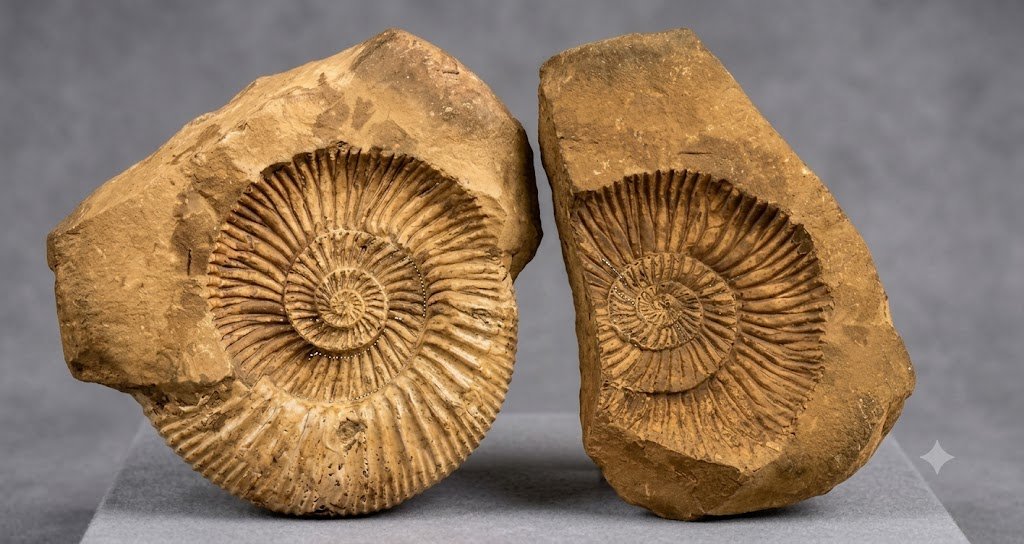
Where life's journey ends in stone, time's twin spirals bloom from a shared heart! This remarkable "matched pair" (often called a "part" and "counterpart") is generated when an ammonite—an ancient marine mollusk with a spiral shell—becomes fossilized within a rock nodule. Over millions of years, the shell itself might dissolve, but a perfect mold of its complex internal and external structure remains within the surrounding stone. If that nodule is later found and carefully split along a natural plane, it cracks open precisely where the fossil lies, revealing the two perfectly opposing faces: one piece showing the detailed mold (a depression) and the other a complementary cast (a raised shape). These fossils are typically found within sedimentary rocks, specifically inside limestone or shale nodules (concretions). The fine-grained nature of these rocks is crucial for preserving the intricate detail of the ammonite's shell. They are found worldwide where ancient Mesozoic seas existed. Notable and famous locations include the Jurassic Coast of Dorset, England (known for nodules that split neatly), regions in Madagascar, Morocco, and the Western Interior Seaway of North America (such as the Pierre Shale formation). In geology and paleontology, ammonite matched pairs are highly prized for the exceptional detail they preserve, often allowing for a full 360-degree reconstruction of the creature's shell. Culturally, they have been symbols of longevity and good fortune for centuries; the Greeks believed they were petrified snake heads, and in medieval Europe, they were known as "snakestones." In metaphysical beliefs, the ammonite's constant spiral is associated with eternal cycles, deep time, and continuous transformation. This spiral is often seen as a symbol for the Fibonacci sequence (the Golden Ratio), grounding a person to natural, cosmic order. Placing a matched pair together is believed by some to harmonize forces, acting as a grounding tool that connects a person to the ancient wisdom of the Earth. It is considered a stone of protection, providing stability and removing negative energy. Ammonites are popular as unique collector's items and exhibition pieces. They are widely used in jewelry (especially smaller ones which are cut and polished) to create earrings, pendants, and rings. Large, aesthetic specimens are used as high-end decorative pieces in interior design. This prehistoric secret, indeed splits open to reveal mirror images of eternal rotation!