
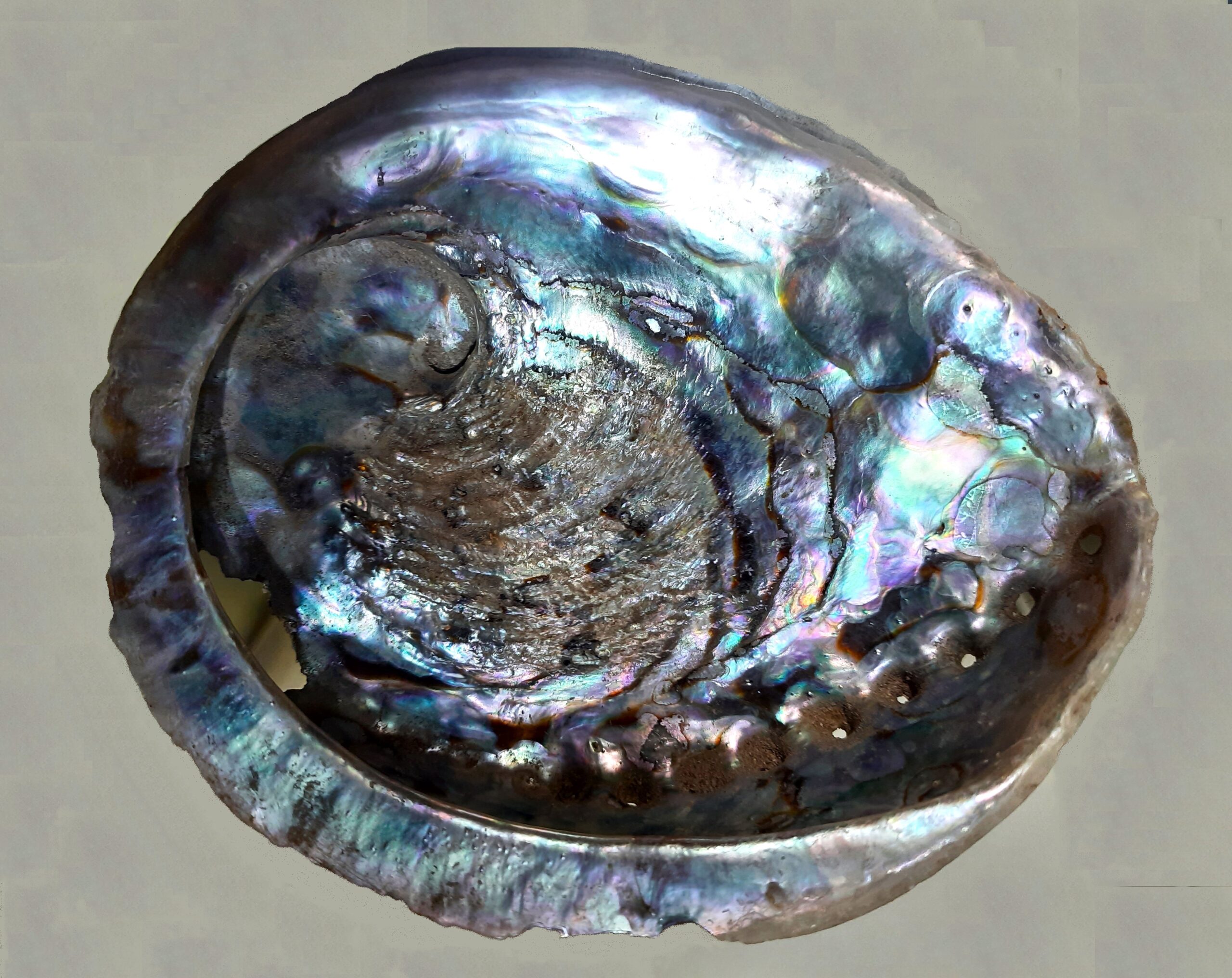
Abalone Shell
This shell is a captured galaxy of opalescent seas, swirling with cosmic hues within a rugged, earthen vault. The abalone shell is valued for both its physical beauty and its symbolic properties across various cultures and industries. The type of abalone determines the specific coloring in the shell (e.g., the Haliotis fulgens is known as the “green abalone”, and Haliotis iris (Paua) displays rich and deep iridescent blues, greens, and purples). Commercial sources of the shell are the Pacific Coast of North America, Australia, New Zealand, South Africa, Japan and Southeast Asia. In many Indigenous cultures, particularly within the Americas, the shell is used as a vessel to hold and burn sacred herbs like sage, sweetgrass, or cedar during smudging and purification rituals. Their natural respiratory pores provide oxygen flow, making them ideal heat-proof holders for burning herbs. The tough, interlocking structure of calcium carbonate and mother-of-pearl (nacre) has inspired innovations in biomaterials, offering models for developing extremely strong, lightweight synthetic materials. The shell is seen as a symbol of protection and the element of water. It is associated with promoting emotional balance, soothing anxiety, and connecting with the gentle energy of the sea. The inner, iridescent layer of the shell is called nacre (Mother-of-Pearl). This material is highly prized for its lustrous, rainbow-like sheen. The shell is cut, polished, and shaped to create stunning pendants, earrings, brooches, and inlay work for instruments (like guitar fretboards) and furniture. Larger shells are used as decorative objects, soap dishes, or as part of coastal-themed art installations. While all abalone can produce pearls, they are relatively rare and highly sought after for their unique, often asymmetrical shapes and intense, vibrant color palette. Abalone are sometimes used in aquaculture to culture pearls, although this is more challenging than with oysters.