
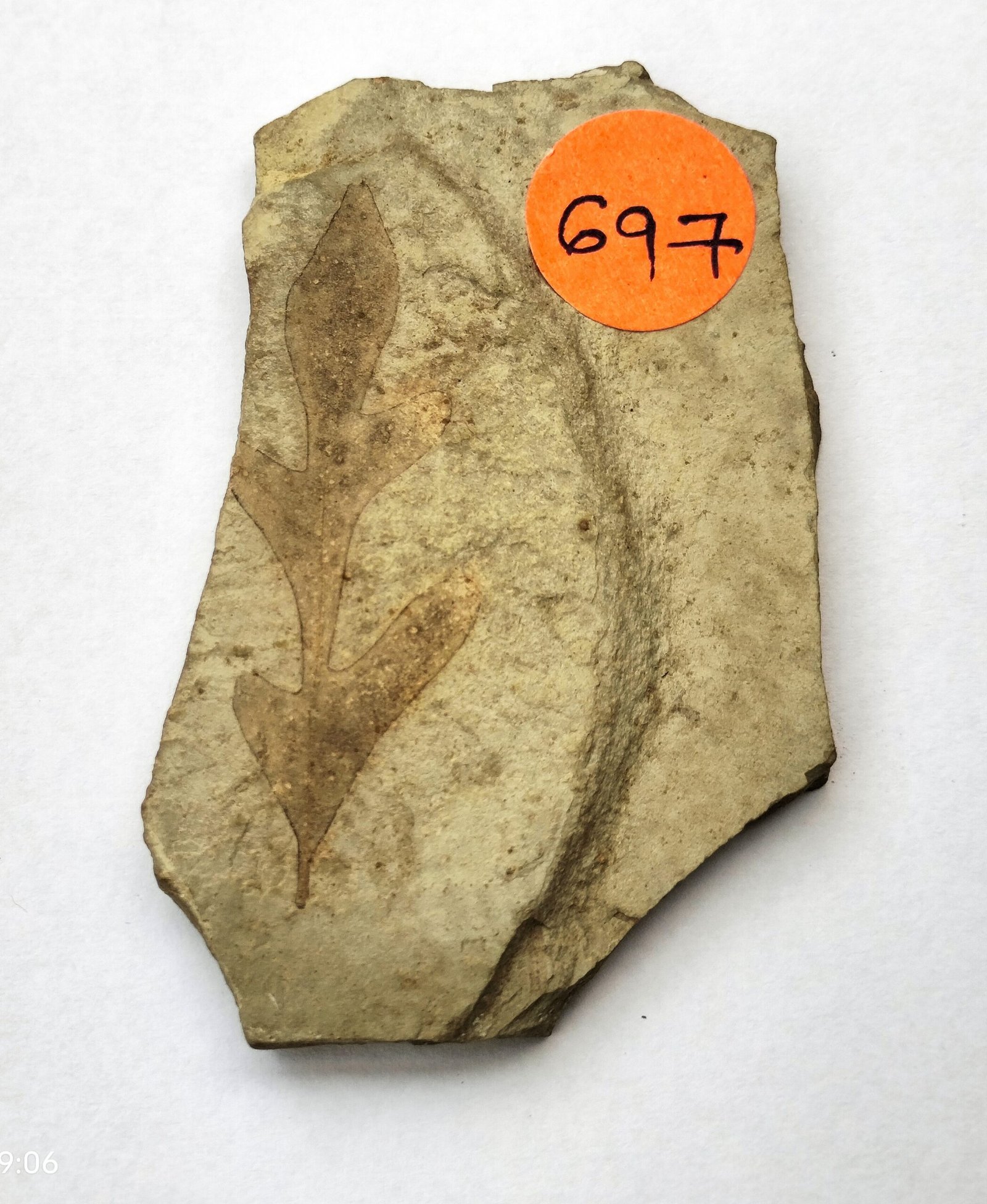
Leaf imprint fossil
This fossil leaf is Earth’s quiet memory, preserving the graceful contour of prehistoric light and life! The leaf impression shows a pinnately lobed structure with prominent, asymmetric primary and secondary venation. The deeply cut sinuses and rounded-to-subacute lobe tips closely resemble the foliage of fossilized Quercus (oak species) or Ginkgoites / Platanus relatives common to Cenozoic flora. The specimen retains a well-preserved carbonaceous film along the central rachis, though fine tertiary venation details along the lobe margins are partially weathered or obscured by the surrounding matrix. The host rock is a fine-grained, lacustrine or floodplain mudstone/siltstone. The light buff-to-grey color of the matrix indicates deposition in a low-energy, oxygen-rich fluvial or lacustrine basin where rapid silt accumulation buried the organic matter prior to decay. The probable Era/Period of this specimen is Paleogene to Neogene Period (approximately 15 to 50 million years old), typical for well-preserved angiosperm leaf compression fossils found in lacustrine shales. It occurs in Green River Formation (USA), the Boltysh basin (Europe), or similar continental lake-bed deposits across North America and Eurasia. Serves as a vital proxy for paleontologists to analyze paleoclimate conditions, ancient atmospheric carbon levels, and prehistoric plant evolution. Makes a unique natural accent piece for home or office decor, bringing organic textures and a connection to deep time into modern spaces. It is highly valued in stone healing traditions as a powerful grounding aid, symbolizing endurance, connection to Earth’s origins, and steady growth through time.