
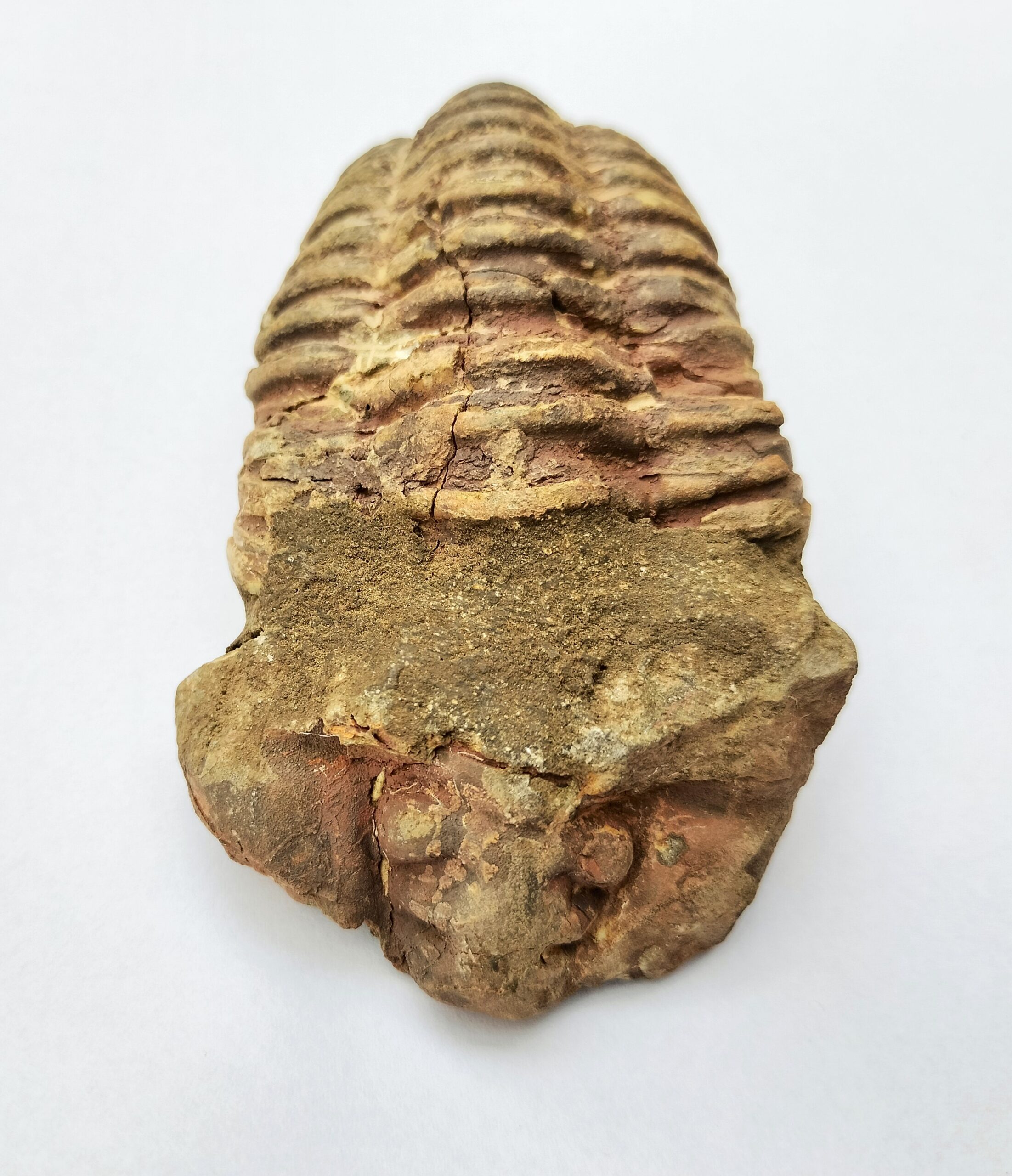
Trilobite fossil specimen
This is a segmented creature of the primordial tide, now sleeping in the eternal silence of rust and stone! The remarkable specimen is fossil Trilobite, one of the most successful and iconic creatures to ever inhabit the Earth’s ancient oceans. This specimen is an extinct marine arthropod belonging to the class Trilobita, which flourished during the Paleozoic Era (roughly 521 to 252 million years ago). The name “trilobite” is derived from its characteristic three-lobed body structure: a central axial lobe flanked by two pleural lobes. This fossil clearly exhibits a well-defined, segmented thorax and the remnants of the cephalon (head section). The earthy, reddish-brown coloration suggests that the original organic matter was replaced by iron-rich minerals like siderite or limonite during the millions of years it lay buried in sedimentary rock. While trilobites are no longer living, their fossils provide immense value to both the scientific and spiritual worlds. Because they evolved rapidly and were widespread, trilobites are “index fossils,” helping geologists determine the relative age of the rock layers in which they are found. They provide evolutionary record of some of the earliest complex eyes and respiratory systems in the animal kingdom. Scientists in the field of Paleogeography use the distribution of trilobite species to map the movement of ancient continents (plate tectonics). In the world of crystal and fossil healing, trilobites are regarded as symbols of resilience and time. They are believed to carry the energy of survival, helping the wearer or owner persevere through long, difficult transitions. As “stones of the earth,” they are used for deep grounding, helping to connect one’s personal history with the vast history of the planet. Historically, some cultures viewed trilobites as symbols of leadership and protection due to their “shield-like” appearance. Due to their intricate geometric patterns, trilobites are highly prized by collectors as “natural sculptures” that bring a sense of deep time and history into a home or office space.