
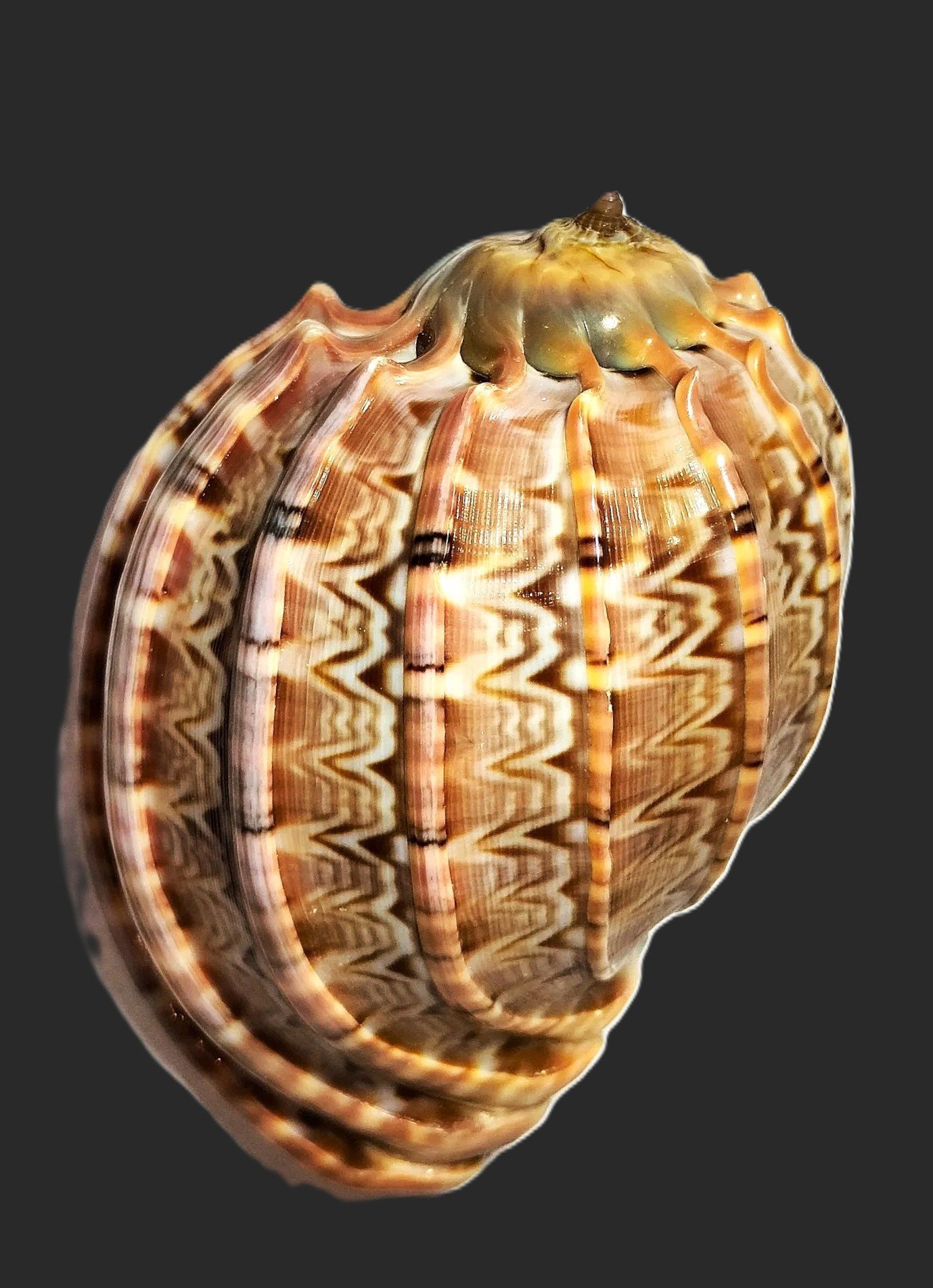
Harp Shell (Sarpa Koodu)
Nature’s perfect crescendo, where sculpted ridges hold the quiet melody of the deep! This Harp shell exhibits a rich palette of warm earth tones. The background is typically a creamy beige or light tan, transitioning to a distinct, darker golden-olive or greenish-brown hue near the apex (top). The pattern itself is defined by deep chocolate-brown and black markings. It features prominent, widely spaced, rounded axial ribs that run lengthwise along the body whorl. Between these ribs are complex, zigzagging or tent-like patterns (often called “chevron” or “flame” markings) in darker brown, bordered by fine, dark lines. This creates a visual effect resembling the strings of a harp. Harpa shells are marine gastropods found in tropical and subtropical waters worldwide, primarily in the Indo-Pacific region, the Red Sea, and along the western coast of the Americas. They generally inhabit sandy bottoms in shallow to moderate depths, where they bury themselves during the day to hunt for prey (like small crabs) at night. Due to their intricate patterns and elegant, sculptural shape, they are highly prized by shell collectors for display in homes, offices, and museums. Their polished surface and aesthetic beauty make them popular for use in artisanal crafts, including jewelry making (pendants, earrings) and decorative mosaics. For biologists and shell enthusiasts, the specific ribbing and pattern variations across the Harpa genus are important for species identification and understanding molluscan evolution. They are considered lucky or auspicious, and may be used in Feng Shui or spiritual practices.