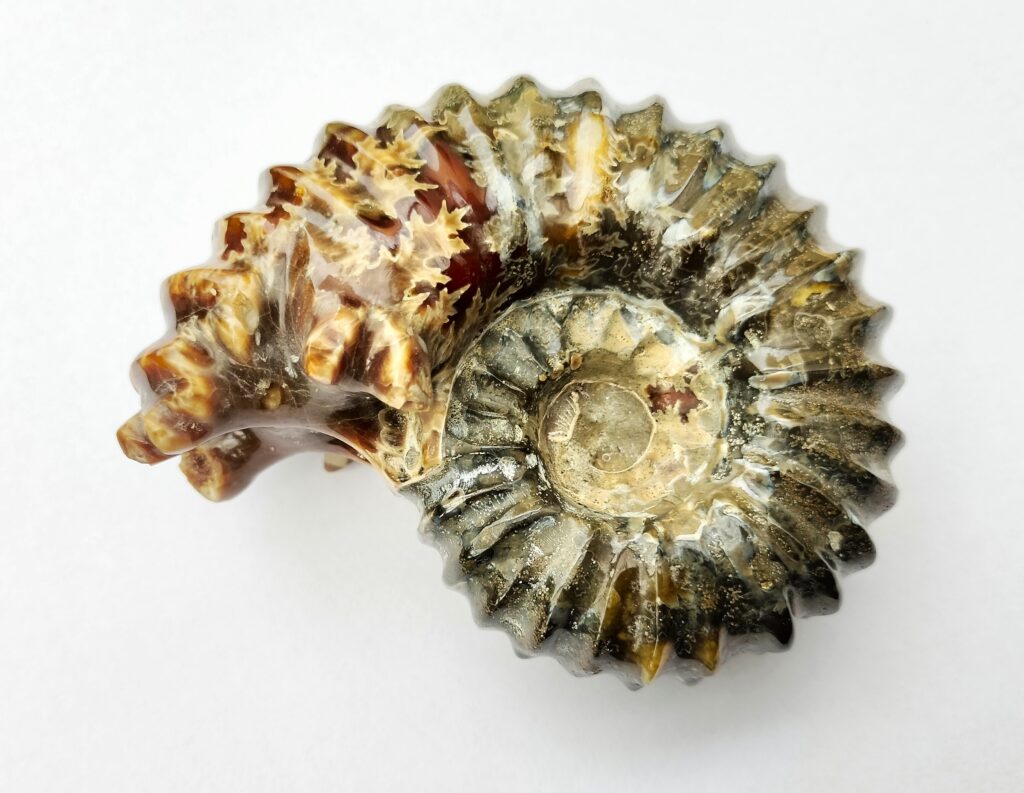
This ammonite fossil features intricate golden sutures tracing the silent rhythm of eons, and coiled forever in luminous harmony! It has a high-gloss finish highlighting rich amber-brown, dark bronze, and golden tones. It exhibits prominent, sharp radial ridges along the outer whorl and beautifully exposed ammonitic suture lines—delicate, fern-like pattern traces where internal chamber walls met the outer shell. It likely belongs to the order Ammonitida recognized by its robust, nodular or ribbed architecture and complex, highly frilled sutures visible across the polished surface. Originates from fine-grained sedimentary rocks such as limestone, calcareous shale, or marl, where mineral-rich groundwater slowly replaced the organic structure with agate, calcite, or aragonite. It occurs in Cretaceous fossil beds found in Madagascar (famous for polished, agate-filled specimens), as well as deposits in Morocco, Russia, and parts of Western Europe. Metaphysically, the combination of spiral geometry and crystallization is believed to awaken inner strength, draw out negative energy, and foster continuous growth through life's cycles. It is valuable as high-end decorative collector items, meditation stones, museum display pieces, and cut-or-carved focal stones in bespoke fine jewelry. Ammonites from the Gandaki River in Nepal are known as Shaligrams- manifestation of the Hindu god Vishnu. The spiral shape symbolizes continual change and evolution. Ammonites are used for activating Kundalini. It is believed that ammonites bring good health, prosperity and success.